Atemporality: Our Relationship To History Has Changed

Within the ephemeral solution of atemporality, storyteller Nerdwriter1 poses an important question in about the way historians and their audiences interact with narratives of the past. Why does it feel like we are moving away from what we once accepted as truth? A clear, pixelated proponent of modern technology, the YouTuber pins a global, growing malaise surrounding the academic history on a greater dissemination of different forms of knowledge due to “the network.”

I believe Public History could and should be created within this network. Around minute 4 he slowly annunciates, “We. Have. Access.” Access for the people to material evidence and an ever-expanding wealth of writing have revolutionized history and historiography, but it also hightlights an tension within the field. How do we create “coherent narratives” within such a chaotic space?

A Trip Down Memory Lane

Canadian filmmaker Arthur Lipsett calls this avant-garde collection of a half-century of newsreel footage a time capsule. Made in 1965, it certainly begins by imparting a woeful nostalgia, but delving deeper into the realities of history is a dangerous dive, and A Trip Down Memory Lane reveals itself to be dark and unsettling. Watch through to the end for the full effect.

Director: Arthur Lipsett
Producer: Donald Brittain
Website: National Film Board of Canada

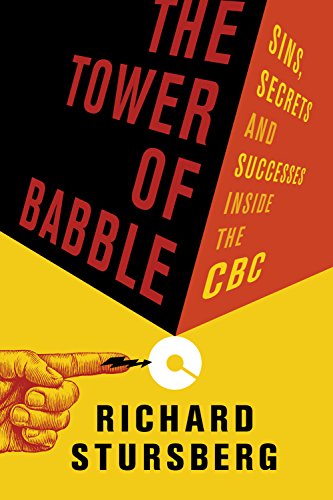
Babble-on: long live Richard Stursberg’s Canadian cultural empire

Written for Randy Boswell’s “Journalism Now and Next” course in 2016.

Some people might think media labour disputes, sports contract negotiations, and upper-level managerial disagreements are boring and make poor subjects for a full-length book. Those people are wrong. The gun-slinging Richard Stursberg will revel in proving them so.

The Tower of Babble is a man’s recount of the business and politics in his six stormy years as the head of English services at the CBC. Stursberg’s mission was to stop the CBC’s slide in market share and lift it from irrelevancy. His commentary explains his controversial moves in power: the axing of high-arts shows; the implementation of “edgy, amateur-driven” entertainment “working within understood narrative traditions;” and the reimagining and diversification of “Fort News.”

His memoir reads like a Martin Scorsese film about the CBC and Stursberg is the bold, brilliant Wolf on Mean Streets Goodfella you can’t help but root for.

It’s a personal retelling of one man’s uphill battle against an endless queue of frenemies to save Canada’s public broadcaster from obscurity. As the former head of CBC’s English services, Stursberg clashed with the Corporation’s president, its board of directors, Senate Committees, CTV, TSN, its own news department, newspaper columnists and more. The book is a crimeless power drama: shots were fired (yeah, he is looking at you, Hubert Lacroix), valuable sports properties were stolen (by Ivan Fecan of CTV) – through it all, Stursberg had a vision and he was not afraid of who he might offend on his path to achieve it. Like Scorsese’s high flyers, he also has a consistent taste for expensive restaurants.

With the framing of a skilled director, Stursberg adds distinctive wit and undeniable flair in detailing his reign at the CBC. Events, characters and conversations are seen through his executive lens, leaving an entertaining – but distorted – reality for the readers to decipher themselves.

For dedicated viewers and listeners of the CBC, Stursberg shines a stage light onto the mysterious business of television and radio. You’d be surprised how riveting the ins and outs of advertising revenue, the scrambled politics and technicalities of running a public broadcasting corporation can be. But what is the role of a public broadcaster? What should or shouldn’t the people-owned CBC be? Underneath his questionable and argumentative recollections, Stursberg’s personal tirade against the stoic, staid, old and boring echoes a broader and more important issue.

What do Canadians truly want from their national public broadcaster – and does it really matter what they want?

Stursberg backed now-cancelled shows like Little Mosque on the Prairie, Battle of the Blades, and Being Erica, which were lauded as “dumbed-down,” “Americanized” entertainment by his opponents. Yet they attracted bigger audiences than any of the CBC’s previous productions.

Canadians were watching these situational comedies and reality elimination shows in droves and ignoring the Corporation’s venture into high-arts television programming, but still Stursberg found himself at loggerheads with the president and board. The latter wanted a mandate of “culture and democracy” while the former wanted to fight the anti-noble fight for the future. After six long years and nine short chapters, Stursberg claims he was fired for his incoherent vision.

News consumers no longer want to hear the stoic Voice of God on the radio. They don’t want to see him sitting behind the staid, big desk with a four-by-four inch photo next to the right ear of his old, precious, silver-haired head.

Audiences definitely don’t want to sit in front of the television for the two-hour special Scotiabank Giller Prize event. What are the Gillers? They will ask. Who cares? They will answer.

Still, there is something to be said for quality arts programming. The CBC is charged with being the lone soldier in a cultural struggle against its closest neighbour and greatest ally. It is Canada’s most important cultural institution – shouldn’t it try to distinguish itself from the American media monster? Shouldn’t Canadians be moved to read André Alexis’ impassioned Fifteen Dogs?

Cultural elitism is one factor of many that has contributed to the doom and gloom of today’s news industry. Journalists and news organizations want to educate and enlighten their audiences on politics, industry, and important cultural arts – and the audiences are turning away. They have been for decades. Stursberg’s opponents at the CBC need to cut through the blither blather of elitist programming and look for a balance of quality arts and accessible entertainment to draw Canadian eyeballs back to Canadian programming.

As a book, the movie analogy still works. It is one man’s symphony blasted and blaring at his former foes rather than a fair account of his turbulent years at the Corporation. More of a block-blunder action than an Oscar-worthy documentary. Tower of Babble is an entertaining memoir with more blister than balance. All in all, it is worth the read.

An Act of Remembrance

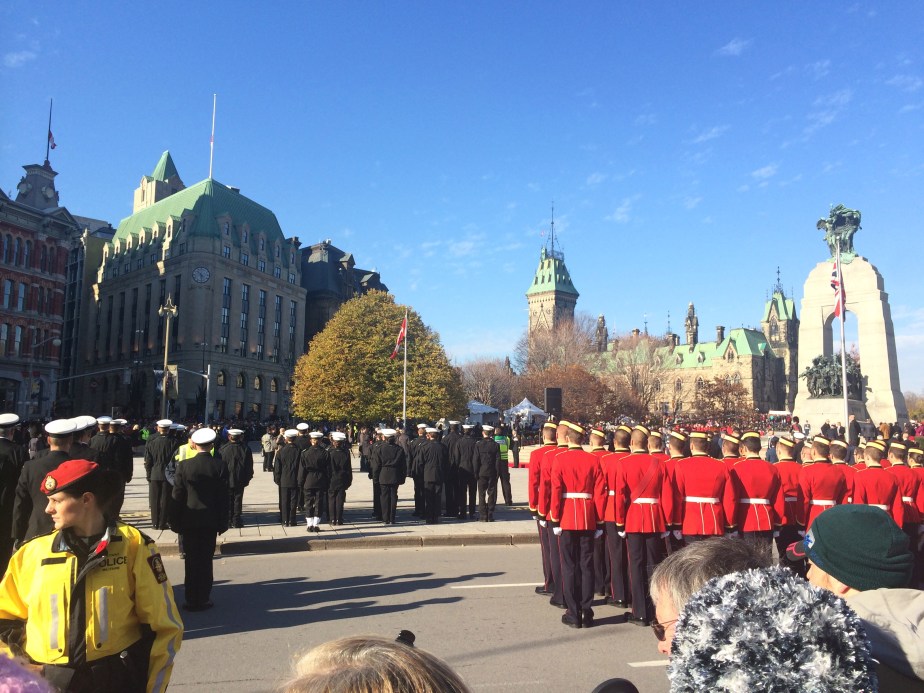
On a crisp November morning, sunlight warmed the faces of tens of thousands of Canadians who gathered in Confederation Square to remember the men and women who have fallen for their country.

Not far from where Cpl. Nathan Cirillo fell three weeks ago, Gov. Gen. David Johnson rededicated the National War Memorial for the second time in the name of all who have died in the service of Canada.

No one will soon forget the attack on the capital. Heightened security was poignant in the square. All major roads surrounding the monument were blocked off and heavily patrolled. Watchful guns topped the roofs of nearby buildings and loudly accompanied the sides of roaming personnel in both caution and confidence: nothing bad will happen here today.

But while security froze in chilly memory, spectators warmed to the sight of a sea of uniforms. For one Canadian history high school teacher, who has attended the ceremony for twenty years running, it was a new and nostalgic experience. “Everyone’s a bit on edge this year, after what happened. But it still means the same thing. We all just have more to be grateful for,” said David Leduc from Montreal.

Veterans, families, and spectators from all over stand for the fallen.

Cirillo was on every mind, in every heart.

Monica Brown and her fiancé Marc Gallant travelled to the nation’s capital from Halifax, Nova Scotia just for the ceremony today. She wanted to take the time and effort to “stop and pause and remember the amazing things.” For Brown, it was impressive to see the sheer numbers of veterans and their families, and to stand amongst them.

Allan Cohoon, an active member of the Canadian Army stationed here in Ottawa, doesn’t see Remembrance Day as a solemn one either.

Icy hands clapped and clapped for the veterans of Canada who have served in wars past, present and future. This year marks one century since the beginning of the First World War. First dedicated for the Great War in 1939, months before the start of the Second World War, the National War Memorial now represents all Canadians in every war that has and hasn’t happened.

Unofficial estimates range from 30,000 to 80,000 in attendance. People stood on the streets, climbed up stairs and onto ledges, and even watched from their office windows.

Johnson said Canada will continue to remember the sacrifices. “Today we stand as one, in silent tribute, not only to keep the vow made long ago but also to rededicate this symbol of that promise.”


Awkward. My first assignment in J-School

What follows is archival evidence from my first weeks in j-school. I chose to leave the awkward word choice. Warning: it is painful to read. Did I really applaud Jennifer Connelly for being pretty? Mighty pen!? *Face palm*

_______________________________________________


Why journalism?  This question has haunted every conversation I’ve partaken in since the day I accepted Carleton’s offer.

I want to be a journalist because I was never meant to be one.  I was not one of those students with a natural affinity with the written and spoken word; both reading and speaking were arduous tasks . However, soon after I was introduced to J.K Rowling’s claim to fame, I drowned myself in pages of print. With a newfound reading habit, I slowly taught myself to love books, leading me to love and practice the written word. Journalism allows me to pursue this passion in all aspects of my life.

I want to be involved and in the know. I want to meet interesting people and see interesting things. I have always had a thirst for knowledge; looking at everything with inherent curiosity. Journalism can give me the opportunity to never stop learning about the world we live in.

I want to travel the globe and expand my worldview. For most, it was Leonardo DiCaprio that made Blood Diamond an immediate favourite.  For me, it was Jennifer Connelly and her character as the pretty, persistent investigative reporter that forced me to watch the movie four times. As with every aspiring journalist, I dream to sweat and bleed in a faraway continent writing a world-changing exposé.

My parents, who once dreamed every parent’s dream, were more than disappointed with my choice of the mighty pen over the road to medical school, so I told them a few of the many strings that pull me to the newsroom. Hearing my passion, they have since pushed that dream into my younger brother. Maybe we can both grow up to save lives.