This summer, I was lucky to be working with the Canadian Tulip Festival as a curatorial assistant to create a small exhibition for the World Tulip Summit in October 2017 and the next Canadian Tulip Festival in May 2018. It was my job to research the history, search for artifacts, and write the exhibit text. The contract was only nine weeks long. If I’m being honest, I felt a little like a fish out of water. Off the stove and into the oven? I’m not great with idioms.
Most of the time, my student job looked like this:
There were few historical materials available to me at the beginning of my contract, as The Festival had recently moved into a small office space at in the Horticulture Building at Lansdowne. I spent the first week reading through a previous archive student’s notes and emailing local museums in hopes they may have some tulip-related artifacts in their collection. There was a noticeable void of material. In desperation, I decided to think out of the box and put out a call on Reddit Ottawa…
“To all tulip festival goers past and present: Do you have any old knick knacks, posters, pictures, or artifacts from past Tulip Festivals that I can use for a project? I’d give you full credit for your items. Putting together an exhibit of sorts.”
Redditor and local historian Dave Allston replied with a clue that would lead me on a journey to the Reid Farmhouse on Sherbrooke and Reid, just off of Carling Avenue, and to some difficult curatorial decisions. The Farmhouse is a dusty, forgotten-in-time structure slated for demolition built in 1865, and at one point, it was the only three-story home in Kitchissippi. This makes the farmhouse one of the oldest buildings in the Ottawa region. Astonishingly, it also happens to be the storage space of a decade’s worth of Canadian Tulip Festival materials!
The Reid Farmhouse has been renovated and reconstructed so many times, it was unable to attain a heritage designation.
One room of materials. An historian’s wildest dream/nightmare!
Unfortunately, because the building has been modified at various times, the structure could not attain a heritage building designation. The Reid farmhouse will maintain a small portion of its first floor and be revamped to better fit the needs of the Kitchisippi community. Moreover, because the Canadian Tulip Festival experiences a high staff turnover, the artifacts in storage were almost entirely forgotten about.
On two separate occasions, I swallowed my vehicular fears and got behind the wheel of a coworker’s old pick up truck that has neither air condition nor interior car lights. Together, we sifted through dusty photo albums, financial reports, posters, objects and rat-droppings; selected the most important materials; and hauled boxes and boxes of them to back to headquarters. Today, our little Horticulture Building office is pressed for elbow room.
I was also faced with (what I think is) the classic curatorial dilemma. My original problem of not having enough materials was now the inverse — I had an enormous excess. How to go through it all?
After consultation we decided to write a story about the tulip as a symbol of international friendship, using images and objects that were shared between Canada and our friendship countries around the world. My favourite object is a wooden Japanese flower vase, a gift from the Japanese delegation in 1997. The vase will be shown with a fresh ikebana flower arrangement, created in collaboration with the Ottawa Ikebana Chapter.
UPDATE:
Here’s a sneak peak of a couple of interesting finds. See the finished exhibit at the World Tulip Summit at the Westin Hotel in Ottawa October 4-7, 2017.
I can hardly thank the Canadian Tulip Festival enough for giving me the space to learn independently and trusting me to take on this project. After these short nine weeks, I have a renewed appreciation for the tulip, and the kind people who take their time to ask people to stop and smell the flowers.
Promotional posters from the 80s when the festival was called “Festival of Spring”.
A carved sculpture from Skagit Valley in the United States. 1999.
This is an excerpt of my final essay for the Directed Readings Course, Migration, Ethnicity, Diaspora I took in Winter 2017 with my thesis supervisor, Dr. Daniel McNeil. MAJOR SPOILERS ahead.
In his seminal essay, ‘Reflections on Exile,’ Edward Said denounced modern culture’s attempts to manifest honest representations of exile, calling its objectifications banal and its beneficial claims mute. An exile of Palestine and Egypt himself, Said described the unenviable condition as “the unhealable rift forced between a human being and a native place, between the self and its true home: its essential sadness can never be surmounted.” Literary productions originating in such unglamorous suffering can hardly be understood by those who read them enveloped by a sense of belonging. He asks: is it not true that these representations obscure the horrendous? Do such cultural productions not hide exile’s affective likeliness to death, but without death’s lenient finality?The nations of Said’s eclectic upbringing are similar to the Hong Kong of the following discourse: none exist as they did due to the recidivism of British colonialism and the politics of nation-building. Handover-era Hong Kong’s unique position of in-betweeness situated a cultural space that tried to answer questions on exile, being, and belonging.
The front page of The New York Times on July 1, 1997.Credit
Here I argue that pre- and post-1997 Hong Kong handover cinema can stand in refutation of Edward Said’s assertion of the humanistic and aesthetic incomprehensibility of modern culture’s representations of twentieth-century exile. The dark, comedic ‘banality’ in Stephen Chow’s desires and necessities, and the excruciating ‘muteness’ in Wong Kar Wai’s strained romantic encounters are a couple obvious examples of well known Hong Kong directors and their ability to put exile to screen. However, much has been written about the international successes of Steven Chow’s use of glocalization in transnational, transcultural filmmaking success and Wong Kar Wai’s masterful command of time and emotion to convey exile and emptiness. I do not wish to add to that canon of literature. Instead, following Žižek’s Lacanian analysis, I want to interpret the less-restrained particularities and revelations found in the Hong Kong B-horror fantasy space of Going Home (2002). Unlike the “auteur of time’s” manner of speaking in ellipsis that entrances international critics and academics, Peter Chan produces diasporic feelings of exile, loss, and transience in Going Home through fear in the juxtaposition of absurdity and familiarity. The film was the third part of Three (2002), a collaborative horror anthology from Thailand, Hong Kong, and Korea.
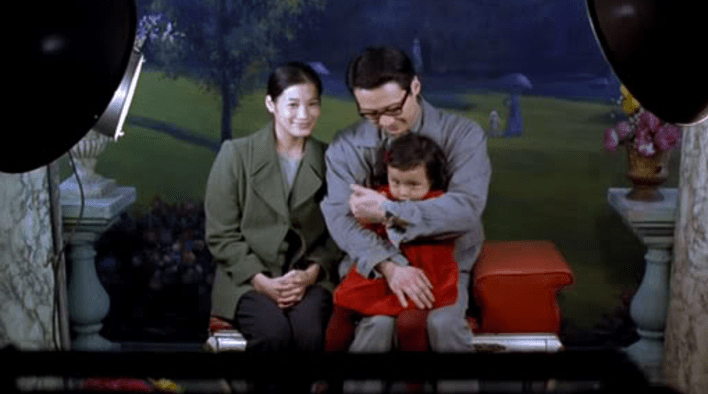
Still From Going Home (2002).
The film is opened in a sea of subjectivity—a young girl in a bright red coat stands amidst dozens of foggy, sepia-toned portraits in a dingy, phthalo green photo studio.A cop, Chan Kwok-wai (Eric Tsang) and his son, Cheung move into a battered, near-vacant apartment complex slated for demolition. Chan learns that only other residents are Yu (Leon Lai), his paralyzed wife, Hai’er (Eugenia Yuan)—both introverted doctors trained in traditional Chinese medicine (TCM) from the mainland—and their young daughter. Cheung catches the girl in the red coat leering at him through windows and behind doors, is unsure why he is afraid of her, but the two become friends and he follows her to the photo studio to play. Upon returning home, Chan cannot find Cheung and accuses the only other resident, Yu, of kidnapping his son. Chan breaks into Yu’s apartment, but stunned to find Hai’er unmoving, breathless and submerged in a bathtub of herbal medicine, he is caught and rendered unconscious. Yu takes the cop hostage because Chan has learned his secrets: his wife Hai’er is dead; he is attempting to bring her back to life with Chinese medicine; and he talks to her every day. Strange, but kind, Yu tells Chan the couple never had a daughter, but aborted their child when Hai’er was diagnosed with a fatal cancer. He plans to release Chan when his wife revives in three days, when they will depart home to Changsha home in the mainland.
In those three days, Chan learns that Yu’s necrophilia and mystical dedication to reincarnation does not make him evil. The two experience intimate moments of friendship while Chan is bound and restrained, and Yu even attempts to find Cheung. On the third day, exactly three years from the day Yu strangled his wife to death to begin the healing process to cure her cancer, and the day of Hai’er’s supposed reincarnation, Chan’s police colleagues arrest Yu and collect his wife’s body. Just as Hai’er’s fingers begin to twitch, Yu escapes from the police and is hit by a passing car and killed. After, Chan watches a video recording of Hai’er speaking to her husband as she uses the same traditional healing process to revive Yu’s dead body. Going Home ends with Cheung leaving the photo studio and Yu, Hai’er, and the girl in the red coat posing to get their photo taken.
Still from the denoument of Going Home (2002).
In Going Home, Chineseness is embodied in Yu, Hai’er, and their dedication to traditional Chinese healing practices. Directer Peter Chan envelops the couple in otherness by contrasting myth/science, traditional/modern, Chinese medicine/Western medicine. Yu’s repetition of the same memory—the moment he met his wife—both speaks her personality into her expressionless corpse and reinforces their shared Chinese identity. In Mandarin Yu lovingly says to his wife’s body, “Do you remember when I first took your pulse?” When the cop yells back from the corner of the room, tied up, that his wife is dead, Yu switches to Chan’s Cantonese dialect with ease: “Yes, Western medicine says she is deceased, but her tumours will be dispelled if I immerse her in Chinese herbs every day. She’ll revive and all will be well.” Their exchange creates the divide between insane Chinese captor and sane Hong Kong captive, but also accentuates the cultural connections through the men’s linguistic fluency. Yu masterfully flits between the dialects and while Chan does not choose to speak Mandarin, he understands it. The language of both are Chinese, but the manner of speaking them are named Mandarin and Cantonese. The ‘I’ speaks language and it is imperative to representation of the self through expression. But language also speaks the ‘I’, in that words shape subjective identities through their inherent histories. Therefore Chan can be read as a defiant Hong Konger, hearing his captor’s tongue but speaking his own Cantonese. Yu can be read as fluid—adapting to the dialect of this different, but similar land.
In his aptly named personal essay, “On Not Going Home,” literary critic James Woods writes that his “softer emigration” is not quite the same as Said’s “desert of exile.” Is the ‘unhealable rift’ finally patched in death? Or does death connote a more permanent desolation? If Said considered exile to be death’s less merciful cousin, were Yu and his family graced by a kinder fate? Although Chan lives, he remains in the desolate complex. His son is nowhere to be found and he remains captive in Yu’s story. Chan seems unable to cross the threshold into a temporality and spatiality can begin its march anew. Earlier in the film, Cheung is afraid of the empty rooms and screams into each one, but only forgotten photographs hear him. He is screaming at walls that do not move, and he is likewise unable to move. Father and son continue to struggle. Perhaps both men are migrants: Yu is not going home and Chan is in exile. In the character’s exploration of being and belonging, it would seem that the former feels the softness of knowing his home, and the latter is left with the discomfort of an untethered identity.
“Going Home.” As part three in Three. Directed by Peter Chan. Hong Kong: Applause Pictures, 2002.
Said, Edward. “Reflections on Exile” in Reflections on Exile: And Other Literary And Cultural Essays, 173-186. Granta Books: London, 2000.
Woods, James. “On Not Going Home,” London Review of Books, 20 February 2014.
Žižek, Slavoj. Looking Awry: An Introduction To Lacan Through Popular Culture. MIT Press: Cambridge, 1992.
“Front Page,” July 1, 1997. The New York Times. https://sinosphere.blogs.nytimes.com/2015/07/01/in-hong-kong-handover-day-is-a-day-of-protest/
8 months, 4 courses, 2 credits, and countless readings later, I have made it to the halfway point of my graduate degree. The year can be considered in other quantitative ways: I taught about a hundred students; was inspired by dozens of exciting ideas; made diverse friends; and shared many, many drinks with them. What follows are general takeaways on my year.
From Journalism to History
The thought of a 30-page final research paper was paralyzing coming from a discipline where our suggested readings consisted of 700-word news articles and the longest written assignments were 1,200-word in-depth reports. The scope of research and writing required was an important incentive to pursue a graduate degree, but it was also the source of some serious imposter syndrome. Looking back at this fear, I can say that I was irrational to think it would be difficult to produce 5,000 to 7,000 word papers when exploring intricate, nuanced, and colourful theories and histories.
It turns out that concise and compelling writing is a highly valuable and diverse skill even historians need. At the beginning of the year, I was worried that my lack of historical knowledge would put me at a disadvantage compared to my peers. Now I think my journalism experience gave me an advantage in synthesizing, writing, and performing information.
NOTE TO A PAST SELF: Girl, relax. What you learned in J-school will only help, not hinder, you.
Being a Teaching Assistant
Learning is a team effort. It works best when everyone is involved in a collaborative and creative project. This is an obvious statement. All professors, TAs, and students technically know this, but collaborative teaching or learning is not obviously or easily practiced.
Kelsea, another TA, and I were assigned to both the Fall and Winter sections of Historians Craft, a second year methodologies course. In it’s fall iteration, there was some effort to work and communicate between professor/TA/student, but it paled in comparison to the winter iteration. The professor ensured that we would always have ample in-depth meetings to discuss assignment ideas, structures and rubrics and logistics of class activities, group work and presentations. To be fair, Kelsea and I were only able to have informed collaboration from our first experience as TAs.
In this learning space we were able to create a few creative products to enhance learning. We organized two classes of student oral presentations, fitting 50 student and various opportunities for feedback smoothly into less than 3 hours of class time. We also produced a public deliverable showcasing student work: a virtual exhibit on Great War objects and monuments.
NOTE TO A FUTURE SELF: Students are a full of useful surprises. They are a wealth of information, ideas, interests, and of course, excuses for late assignments.
“Heritage sites bear the imprint of the politics of the past at different historical junctures, the meanings of which are now embroiled in the politics of the present.”
If you’re up for it, here’s a very long, very sad, very powerful read about public history and living memory in Alabama. It touches on the need to memorialize, to remember, a touching “currency” of memory work, and ends with interesting comment on the spectator’s presence in such lieux de memoires. Have you ever experienced intense emotions in reenactment history? Something about this story collapses temporal and spacial distance. Perhaps it is not unusual for the reader to feel pain and sorrow for a history that still does not feel quite “past” in 2016.
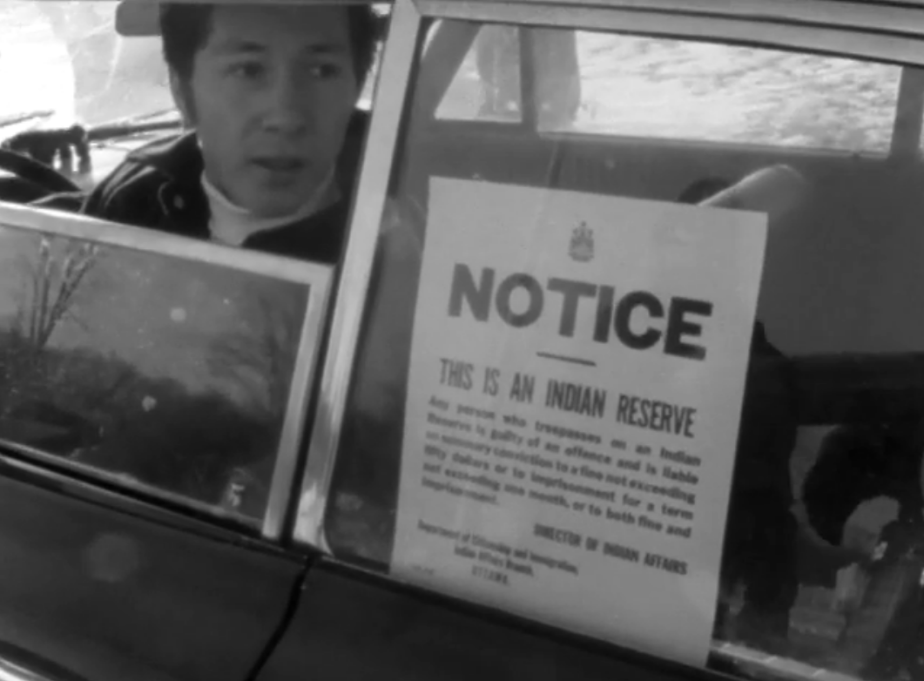
A scene from the short documentary You Are On Indian Land (1969) by Mort Ransen, as part of the Challenge for Change project by the National Film Board of Canada.
Ironically, this film was created with the community with support and funding from the government. It brings together three spheres of national (government funding), local, (community participation) and public (cinematic mobility and reach). The cinematic becomes a gathering place for renegotiations of authority and agency and transforms into one powerful medium — an impetus for change.
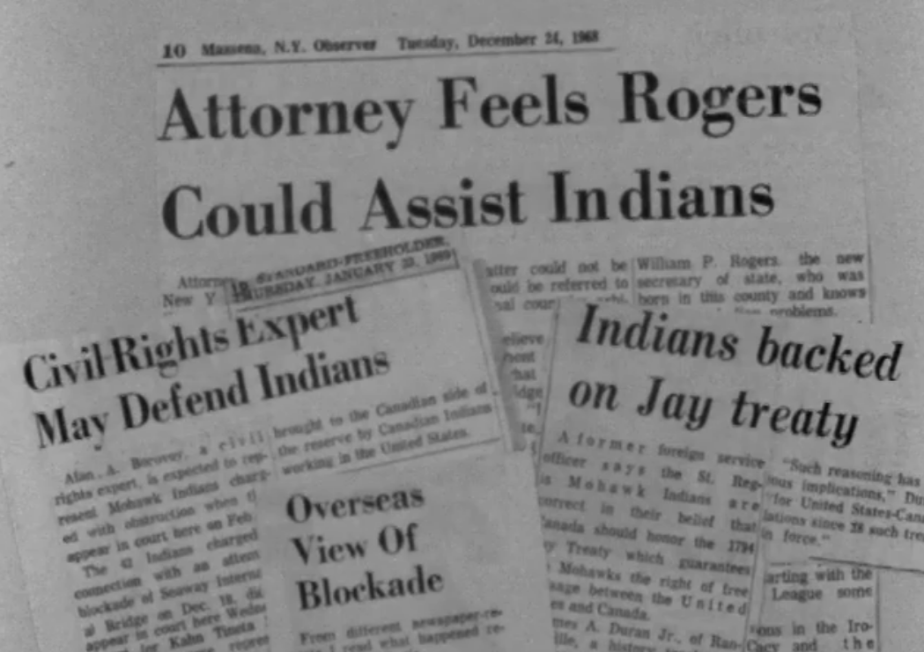
You Are On Indian Land (1969) was filmed in collaboration with a Mohawk activist and filmmaker.This short documentary was part of Challenge For Change, a participatory filmmaking project “braiding” separate threads of power and lack of power into one coherent call to action. The National Film Board project formed The Indian Film Crew in 1968 to encourage, inspire and train First Nations people in filmmaking. Sponsored by private and public stakeholders, participants later went on to work on community development projects.
Affective history has the ability to collapse temporalities.For a film made almost a half-century ago, You Are On Indian Land bears a striking resemblance to present-day politics. The film documents a confrontational “contact zone” where the the Mohawk of the Akwesasene Reserve (then called St. Regis) set up a blockade on a duty road connecting Canada and the United States, where the governments were charging “indians” for crossing on what little was left of their own land. Today, indigenous peoples are part of a new nation, “Blockadia” so termed by journalist Naomi Klein. In places like Standing Rock, Dakota, people are protesting the Dakota Access Pipeline and authorities are using extreme force and incarceration to bully First Nations peoples into submission.
There are moments when there can be no objective divorce between the politics of the present and the study of the past. This is one such moment in the political present where the world we live in cannot be removed from the politics of the past, nor the graduate-level public history assignment.
For Canadians who woke up on November 9th, 2016 to a world they no longer comprehend, it is important, now more than ever, to understand the public historian’s role in civil society, consider our responsibilities by virtue of it, and work to assure the Canadian public does not succumb to demagogic narratives of isolationism, fear, and hate.
Our Role
Public history serves the public — a collection of peoples cohabiting spaces with memory and history. Public historians aspire to honest, context and evidence-based truth-telling. This can be achieved by employing diligent historical analysis, championing multiple manifestations of remembering and using evidence-based storytelling to maintain accountability. Done right, public history can engender learning, healing, and individual and collective development. Done wrong, it can contribute to misinformation, suffering, and painful reminders of our shared colonial pasts.
Our Challenges
There are several stories in Canadian public history professionals need to thoughtfully consider before pursuing future projects. Historicization of public history shows the discipline has authored its own uncomfortable chapters in the ongoing colonial narrative. The field needs to adopt a generous and unflinching reflexivity to see it’s own power in shaping public discourses. Andersen puts it eloquently: “spaces of cultural representation— like museums and national historic sites—can be spaces of mutual recognition rather than mere manifestations of colonial power.” Here are some suggestions on how to do that.
What Not To Do
Do not confine identities in history, as it is in the Batoche National Historic Site in Batoche, Saskachewan. Chris Andersen points to telling “three-dimensional,” high “density” stories of that champion both the Metis’ peoples modern complexities and and historical celebrations as a way to move forward instead.
Do not work in insolation, as the infamous failure of an exhibit, Into the Heart of Africa at the Royal Ontario Museum, mistakenly did. The curators did not fully consider their audiences and the way they might receive the exhibit. Eva Mackey discourages the use of universal claims to truth, especially in such a “powerful agent in defining public culture.”
Do not sanitize violent histories, as former Prime Minister Stephen Harper inadvertently does in a speech during the 2009 G20 meeting in Pittsburg by saying “We have no history of colonialism”. We should not be exempt from remembering traumas 1 year, 1 decade, or 1 century after the highly orchestrated public apology for Canada’s role in residential schools. Healing from traumatic pasts requires remembering with as much deference to truth as possible.
What To Do
Share authority. As Andersen writes, public historians should strive for a “history in between.” Narratives should be situated in between structure and agency; local, regional and global; indigenous and white, commemorative, scholarly and community based remembering. Public historians can look to the c̓əsnaʔəm, the city before the city exhibitat the Museum of Vancouver as a step forward into shared authority and respectfully indigenized history. This in-betweeness also exists between times. Public historians need to recognize what Sharon Macdonald calls the multi-temporal nature of public remembering, that “wrong done in a time marked is recognized as such” but also exists in a present orientated to future. One of the greatest challenges is deciding what to choose
Recognize power and poverty. Museums and monuments hold significant social capital as institutions. Public historians need to recognize the privilege and responsibility that come with storytelling for publics, which inadvertently creates spaces of belonging and exclusion.
Listen. Researches and practitioners in Canada need to adopt the Truth and Reconciliation Commission’s Calls To Action as much as it is feasible. Canadians need to read the TRC adopt it into schools, museums, books and popular culture. In the history of public history, certain narratives were told over the silences of others. To move forward towards reconciliation, we need to hear the quieted truths from quieted voices.
“From a piece of the Wright brother’s plane to a child’s sugar egg, today: Things! Important things, little things, personal things, things you can hold and things that can take hold of you. This hour, we investigate the objects around us, their power to move us, and whether it’s better to look back or move on, hold on tight or just let go.”
Gift yourself 1 hour and 1 minute and let hosts Jad Abumrad and Robert Krulwich from the WNYC podcast Radiolab weave you through 3 stories of what Appadurai calls “the social life of things.” Give it a try! There is no storytelling quite like Radiolab storytelling. If you don’t have the full hour, you can pick and choose which story you want to listen to here. My favourite is: The Seed Jar.
Listen to “Things” by clicking on the image above.
“Narratives of the traditional simply being replaced by the modern don’t work when we need to take into account not only possible tradition invention but also self-aware nostalgia, retro-fashioning, alternative traditionalities, memory work, and multiple ways of being modern, some of which involve being traditional in new, or even old, ways.” – Sharon Macdonald
Introduction
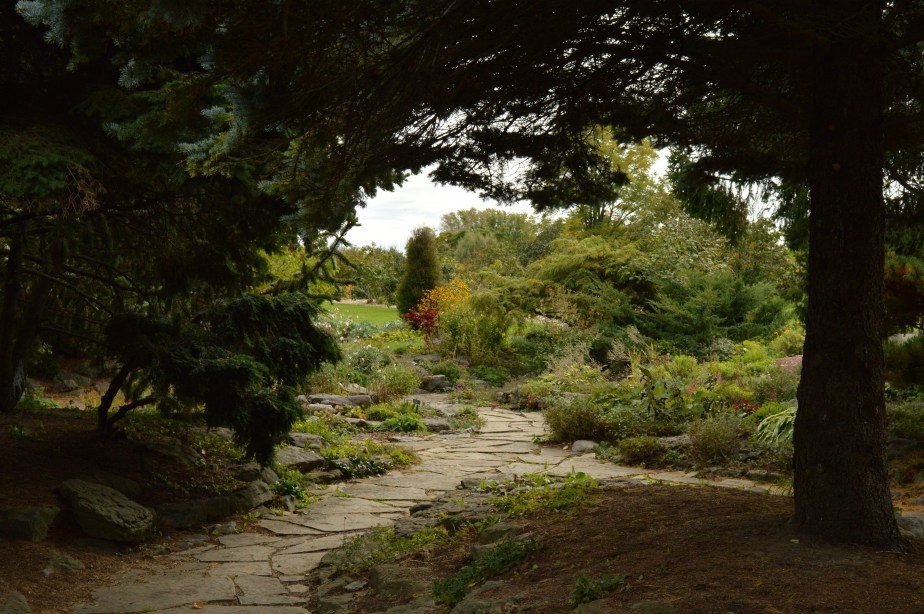
Ottawa’s Central Experimental Farm was borne in circumstances not dissimilar to the beginnings of the Public History discipline — as a result of Victorian era interest and advancement in the natural sciences.The national historic site has welcomed visitors since its establishment in 1886, and continues to touch, influence and affect people’s memoryscapes.Although the site’s 427 hectares contains all agricultural and research facility, working farm, botanical gardens, arboretum, and interactive learning museum and more, I will herein refer to it as the Farm.
Bessies lined up in the cow barn at the Central Experimental Farm.
The Farm’s size and scope allow for a multiplicity of directions for historical investigation, but this research will explore how people who visited the Farm as children remember the site as adults, especially at the Canada Agriculture and Food Museum. Building from Andrew Irving’s experimental methodology “staged fieldwork” as outlined by Macdonald, this research will ask persons who encountered the Farm as children to revisit and relive their experiences in conversation with each other in place.
Research Questions
This research will seek to answer these questions: How do people presently remember and engage with their past childhood experiences at the farm? How have their experiences affected their lives? Which temporality is most prominently represented in events of past-presencing – the past or the present, and why? Do children remember authenticity or an “alternative traditionality” at the Farm?
These questions aspire to unlock “possible modes of experience and telling” that exist when persons act in past-presencing in a unique, socially constructed place such as the Farm. The research hopes to highlight the “creative, not fictive” stories people internalize and relive with others as they interact in place.
Theoretical Evidence
Sharon Macdonald’s idea of past-presencing will be influential in this research. Since the farm’s establishment in 1886 as an agricultural innovation facility for the betterment of national health and prosperity, a modern city has erected and enveloped the surrounding land (and today threatens to encroach deeper). The farm exists not only between times, but belongs in a fascinating multitemporality, where the directions of time intermingle in a negotiated reality.
Memory Park stands sober in the centre of the Museum, the site of the 1996 fire of the barn housing 59 animals and “friends.” How does the naming change the landscape?
Science, technology, experimentation and agricultural innovation are very much of the present and for the future. However, heritage buildings, an idyllic arboretum, and the paradoxical existence of a farm within the City of Ottawa suggest the Farm may act as a multitemporal heritagescape, as Walsh described socially constructed places with produced social meaning. Is it possible to separate the modern food science museum exhibit from the cows and calves sitting behind a picket-white fence? Memory Park stands at the centre of the Museum, where a barn housing 59 animals was lost in the 1996 fire, memorializing the past and naming the site as a place of sensitivity.
Other buildings destroyed in previous fires were rebuilt in their heritage style. Is memory “stickier” at sites of trauma such as these? How do memories collide at this site? Do these adults see the Farm differently decades later? What memories remain? Perhaps the answer will never be fully complete, because as Opp and Walsh write, “the production of place is always unfinished and uneven.”
Considering Pierre Nora’s idea of lieux de memoire, this research will investigate how modernity and authenticity at the farm may coexist in a place between times. Nora deserves some explaination: a lieux can be understood as the manifestation of the break between what Nora understands “traditional” or “authentic” memory work and history, the hollow product of the memory crisis in modernity. The controversial theory offers historians interesting ways to conceptualize memory negotiations and past-presencing at the Farm. The Farm is a cleaner, decorated, meticulously crafted place of learning and reminiscing, but it is not a real farm. Therefore the reimagined, synthetic farm can be understood as a lieux de memoire or an alternative traditionality, a picture of pastoral rural times in a technologically innovative, urban setting. Today, the Museum exhibits a modified retelling of past agricultural understandings to nostalgic visitors, young and adult, who yearn for more authentic understanding of the world beyond the food on their plates.
Methodology
This research will employ a version on Andrew Irving’s experimental methodology in his research on HIV/AIDS he calls “staged fieldworld,” as outlined in Macdonald’s chapter on differential ethnographic research methods.
Participants will be briefed on general ideas of the research and asked to reflect on memories, past and present, and place. Participants who visited the Farm as children will voice record their oral histories with a partner without the presence of a researcher as they walk through the site. Participants will supplement their storytelling with pictures with a camera whenever they feel a need to document the image. These performative memories will explore the ways persons interact with the past in the present, how they remember events from their past, and understand the layers of memory and emotion in a place between times.
During my preliminary research I was lucky to come across a woman in a bright red wool sweater who has been working at the Museum for 12 years. She was between appointments giving lessons on pumpkin varieties in a small classroom connected to the cow barn. In an impromptu interview, she spoke wondrously of first encountering the big sheep as a small girl. She noted how the barn has remained exactly the same, but the sheep no longer seemed like giants when she returned to work at the site decades later. She offered her own opinions and perspectives on reality at the farm without prompting, signalling this research may be welcome among the community.
This slideshow requires JavaScript.
Ethical concerns and resulting methodological restrictions often “mute” the voices of children in traditional histories. This research aims to understand childhood stories, memories, and understandings in the structure of adult retellings. Few events can resurface childhood remembering like the company of an old friend or a new but fellow nostalgic companion. This past-presencing through conversations at the Farm could open up a version of the world as people once saw it and proffer some insight into the ways persons push and pull on individual and collective narratives to come to an understood reality.
In avoiding the scripted questionnaire with researcher vis-à-vis subject, this methodology intends to repudiate unidirectional historical narratives and bridge the gap between Nora’s bifurcation of memory and history by urging participants to practice in a form of multitemporal memory work.
Dissemination of Research
The research will be disseminated to the wider community in podcasts, gathered from the audio recordings during research, edited by the researcher. It is understood the finished audio documentaries will not be what Nora considers a “raw” or “authentic” form of memory — but in the murky negotiations of reality and identify in past-presencing, when is it ever?
Works Cited
Lyle Dick, “Public History in Canada: An Introduction,” The Public Historian 31, 1 (2009): 7-14
Sharon Macdonald, “Telling the Past: The multitemporal challenge,” in Memorylands (2013), 52-78.
Pierre Nora, “Between Memory and History: Les Lieux de Mémoire”, Representations (1989), 26: 7-24.
James Opp and John C. Walsh, “Introduction: Local Acts of Placing and Remembering,” from Opp and Walsh, eds., Placing Memory and Remembering Place in Canada (UBC Press, 2010), 3-21
John C. Walsh, “Becoming a Centre: Public History, Assembly, and State Formation in Canada’s Capital City, 1880-1939,” forthcoming in David Dean, ed., A Companion to Public History (Blackwell, 2017).









 Jenn Leah Ko