This time last year, my HOD and HOS asked me to make an options video for the new course I was launching in the Humanities Department—CIE A-Level Classical Studies.
As an ex-journalism student, I was THRILLED to get a chance to reignite my creative chops and have a chance to play with my beloved Adobe Audition once again. The mini-project also forced me to think about how to make the course more relatable and appealing for KIS’ unique student population. I wrote and voiced the script with their particular interests in mind.
Unfortunately, the video I produced will soon be out of commission because Marketing wants new specifications this year, aiming to create a more cohesive media presence. So… I’ll just archive it here.
Have you ever wondered, Why take Classical Studies?
It’s 9°C in Hong Kong at the moment—veritably freezing for this little isle on the South China Sea—and the CNY holiday has gifted me with some respite to reflect on what might be my most satisfactory period of work to date.
Two years ago today, I was sitting in my considerably chillier Montréal apartment, working from home as a historical researcher, desperately trying to conquer the voices of the void. I loved the research, but I dearly missed teaching. There is something unquantifiably exciting about engaging with young students who are grappling with new ideas for the first time; collaborating with fellow educators who are passionate about the value they bring to a community; contributing to building a more positive microcosm of the school; and embracing the never-ending novelty of learning something every day.
January marks the end of the first term of my second year teaching at an international school in Hong Kong. Due to some career changes, a global pandemic, and some family matters, it’s actually the longest I’ve worked anywhere. This academic year is for other firsts as well: first time teaching humanities and first time serving as a Head of Year.
I had anticipated some challenges prior to taking on these new roles. Would I be able to keep up with all the new content knowledge required of my IGCSE and A-Level courses? (The answer was yes—I actually struggled more with economics within KS3 Social Studies.) Would I be able to prove that I deserved a leadership position in pastoral amongst the many more-experienced teachers at my school? (I hope so—this one I still struggle answering with critical self-empathy.) Could I do this on top of expanding the scope and success of the Yearbook Committee? (TBD—the full publication and distribution should be completed by June 2025.) Would I be able to juggle everything while also completing an assignment-heavy PGCE? (Yes—although I cannot say I did so happily.) Looking back, these challenges appear easily overcome.
Being able to combine my love of teaching with my love for history has been a large tenet of why this first term has been so successful. An astute IGCSE History student, H.N., has asked more than once “why does it seem like you don’t miss being an English teacher?” There’s nothing wrong with the subject of course—I love language and literature, and an aspect I miss more than others is how reading my students’ written work allowed me to know them a little more deeply. More than once, I responded to H.N.’s inquiry by making a joke about how I no longer know how to speak English.
But if I were to answer honestly, I would probably say… I have loved the study of the past since I took four separate history electives in my suburban Ontario high school. Or perhaps even earlier, when my dad brought me to Unionville Public Library during summer break, and I borrowed out my pre-teen weight’s worth of historical fiction. It could be further back still, when my wee brother and I sat with our feet dangling from the dining room table, listening to stories of our family’s diasporic paths. Being able to plan and deliver lessons for a subject I am so passionate about makes every workday a joyful one. Being able to geek out with fellow history enthusiasts brings out the child in me. Being able to inspire students who initially dislike the subject to change their minds is incredibly motivating!
This blog started as an exercise to prove to myself that I can still write without AI, but it seems that I have waffled for long enough. I’ve soliloquised for so long it is now 17°C and I can go enjoy the last of my break with a trip to the beach. Here’s hoping for another good term.
A few months ago, I finally developed a roll of film from my time teaching in Qingdao during 2019-2020. Qingdao, also known as 青島, is a beautiful and bustling coastal city located in the northeastern province of Shandong, China. The city’s strategic position along the shores of the Yellow Sea has endowed it with a unique and internationally-influenced history.
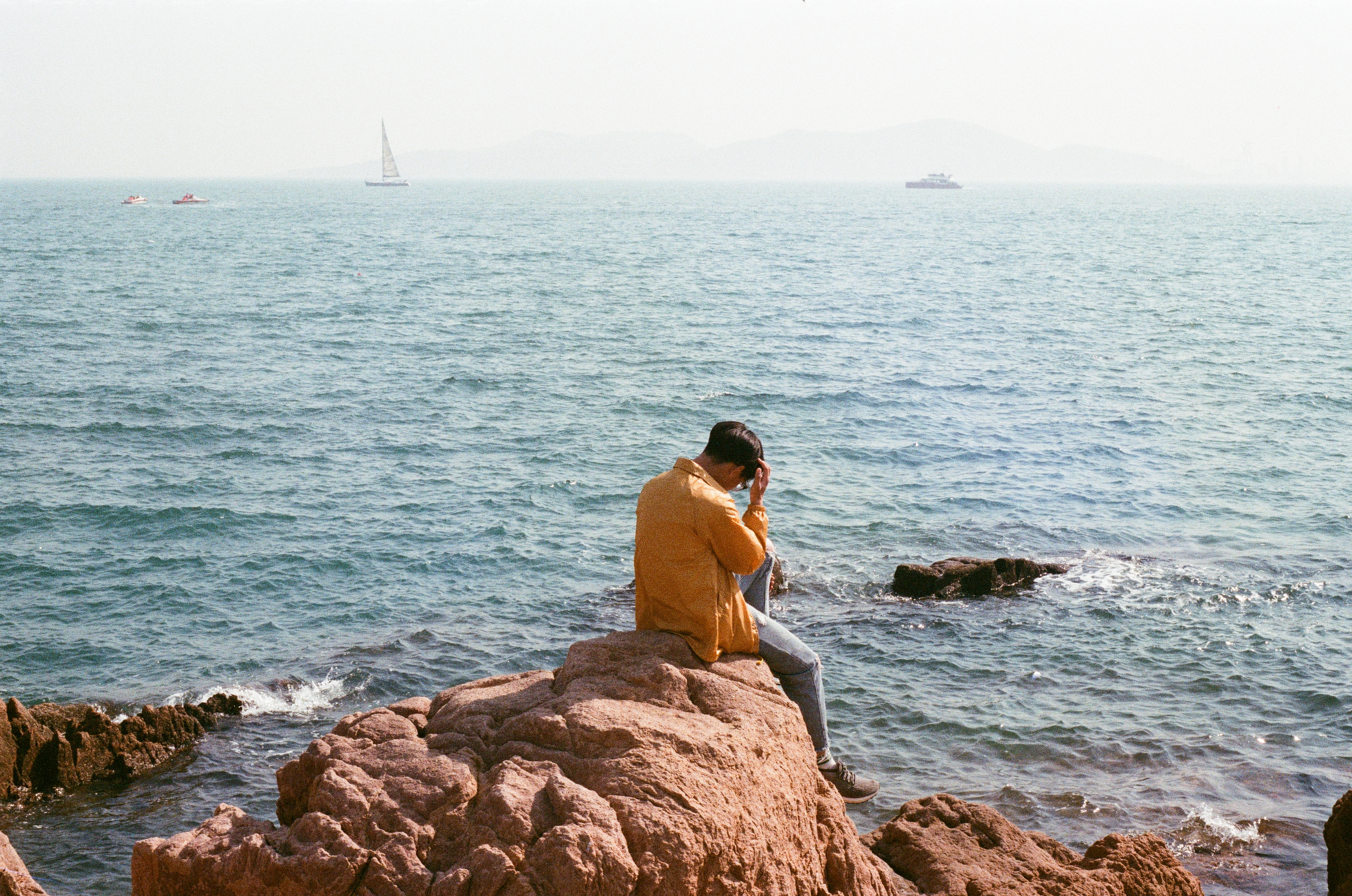
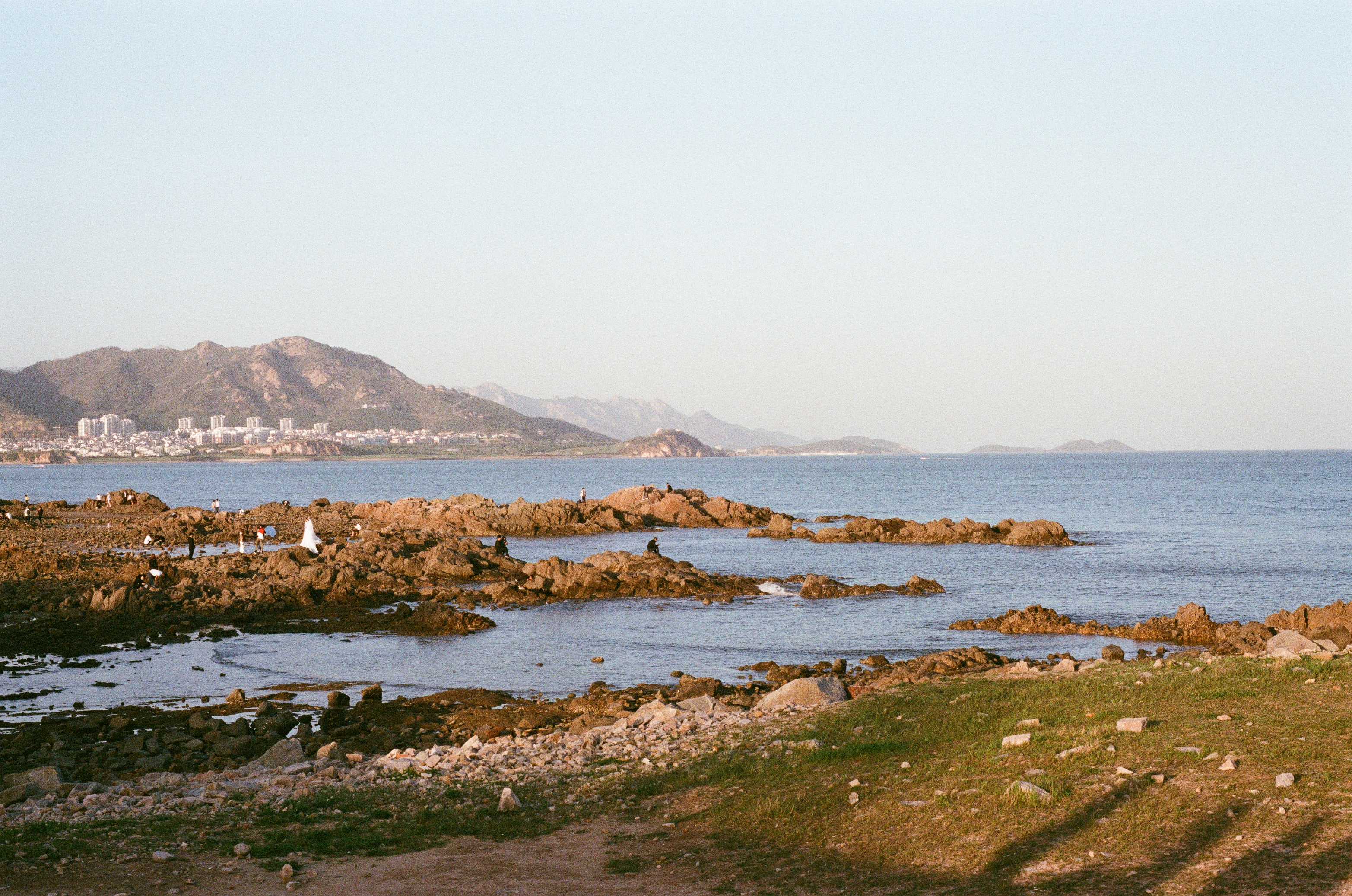
The photographs I captured in 2019 on my Olympus OM-2 using Kodak 400 film truly capture the natural beauty of Qingdao’s breathtaking shoreline, which was a highly contested land for centuries.. The city’s international history has imbued it with a distinct character, making it a fascinating and picturesque destination.
Here’s a little known history that involves China, Japan, Germany, Tiananmen protests and the Treaty of Versailles, told through some old pictures I took. Qingdao originated as a minor fishing village, and during the Qing dynasty (1644–1911/12) it developed a significant junk trade, with a customs station established there. In the 1880s, as the Chinese government set up the Beiyang (“North Ocean”) fleet, they recognized the strategic importance of the location of Qingdao (then known as Jiao’ao) and established a small naval station there, along with building fortifications.
After the devastating first Opium War, China was forced to open its ports to foreign trade. After two German missionaries were killed in 1897, Germany took control of Qingdao and the surrounding Shandong peninsula, establishing the Kiautschou Bay concession. Germany then developed Qingdao into an important economic and naval base.
During World War I, Japan seized the opportunity of Germany’s involvement in the war to occupy Qingdao in 1914. Following Germany’s defeat, the Treaty of Versailles in 1919 awarded the Kiautschou Bay concession to Japan. Japan then created the Tsingtao (Qingdao) Naval District and expanded the port’s infrastructure and industries.
After Japan’s defeat in 1945, Qingdao was returned to Chinese control. The city’s architectural and infrastructural legacy from the earlier German and Japanese colonial periods remains an important part of Qingdao’s cultural heritage today.
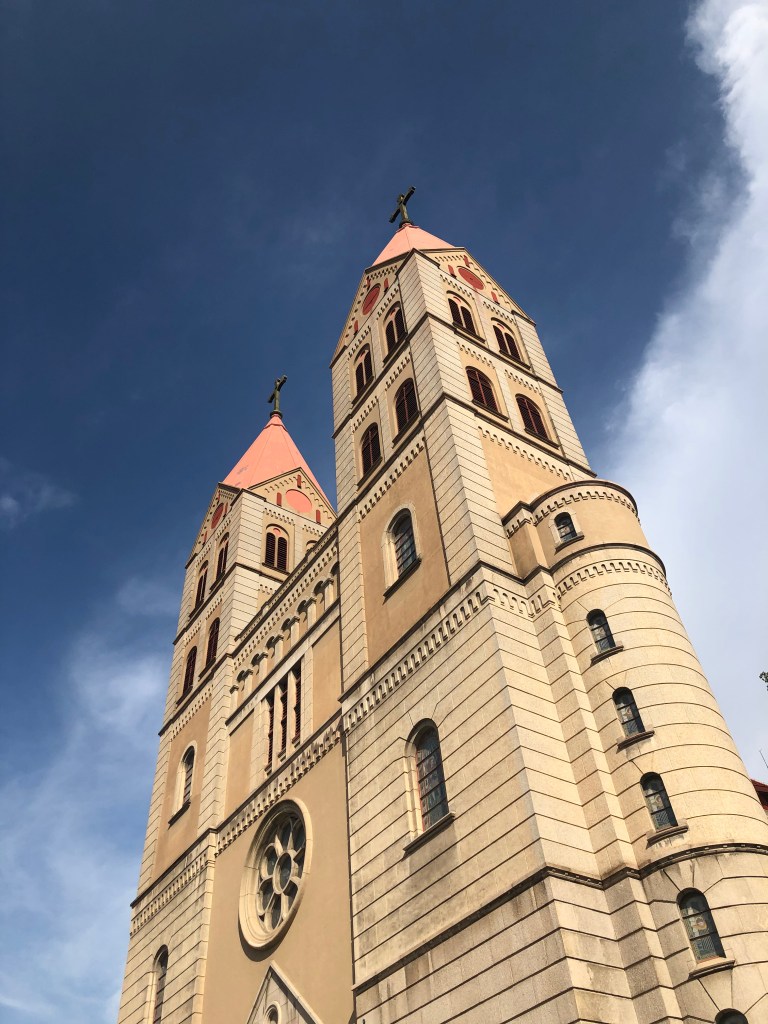
This imposing piece of Romanesque revival architecture is St. Michael’s Cathedral, also called Zhejiang Road Catholic Church. It was built by German missionaries in 1934.
This is the May Wind sculpture in May Fourth Square 五四广场, a major tourist attraction in downtown Qingdao. During the early 20th century, the May Fourth Movement was a pivotal student-led political and cultural movement that swept across China in 1919. The movement arose in response to the Treaty of Versailles, which awarded German colonial holdings in Shandong province to Japan rather than returning them to Chinese control.
In Qingdao, which had been a German and then Japanese colonial holding, the May Fourth Movement resonated deeply. The city’s students and citizens took part in the widespread protests and demonstrations that defined the movement across China.
To commemorate Qingdao’s role in this pivotal moment of Chinese history, a sculpture was erected in the city’s central square. The May 4th Monument features a towering figure representing the student-led movement, symbolizing the city’s resistance to foreign imperialist control and its embrace of Chinese nationalism and modernization.
The monument stands as a testament to Qingdao’s complicated colonial past and its people’s struggle for self-determination. It serves as a powerful reminder of the city’s important place in the broader narrative of China’s 20th century political and social transformation.
Qingdao has a complex history of shifting colonial control, first by Germany and then by Japan, before ultimately returning to Chinese rule. This legacy has significantly shaped the development and character of the city. It was a beautiful place to kick off my international teaching career.
Tension is the invisible but unmissable, enduring force propelling public history and its historiography. Between the state and private institutions with funding; the academics behind the walls of the ivory tower; and the families and individuals whom they are reputed to serve, Ashton notes that the field is fraught with debate. Fostered by modernity and a growing interest in memory in the nineteenth century, Meringolo writes the public historian’s is a profession born in national park preservation efforts, expanded in the 1980s and 90s with consultations with the public, and today democratized by collaboration. According to Dick, individual narratives and collective affect are fundamental to public history. Therefore, it is essential to bring existing but “othered” modes of thinking into the academic and professional fold. But the question remains: How? How can the gatekeepers of history open their doors and work with the public to tell the stories they want to hear without delegitimizing their academic integrity?


 Jenn Leah Ko