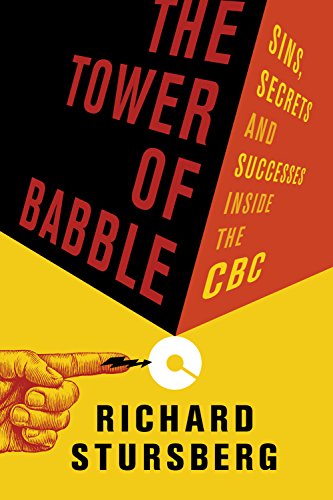
Written for Randy Boswell’s “Journalism Now and Next” course in 2016.
Some people might think media labour disputes, sports contract negotiations, and upper-level managerial disagreements are boring and make poor subjects for a full-length book. Those people are wrong. The gun-slinging Richard Stursberg will revel in proving them so.
The Tower of Babble is a man’s recount of the business and politics in his six stormy years as the head of English services at the CBC. Stursberg’s mission was to stop the CBC’s slide in market share and lift it from irrelevancy. His commentary explains his controversial moves in power: the axing of high-arts shows; the implementation of “edgy, amateur-driven” entertainment “working within understood narrative traditions;” and the reimagining and diversification of “Fort News.”
His memoir reads like a Martin Scorsese film about the CBC and Stursberg is the bold, brilliant Wolf on Mean Streets Goodfella you can’t help but root for.
It’s a personal retelling of one man’s uphill battle against an endless queue of frenemies to save Canada’s public broadcaster from obscurity. As the former head of CBC’s English services, Stursberg clashed with the Corporation’s president, its board of directors, Senate Committees, CTV, TSN, its own news department, newspaper columnists and more. The book is a crimeless power drama: shots were fired (yeah, he is looking at you, Hubert Lacroix), valuable sports properties were stolen (by Ivan Fecan of CTV) – through it all, Stursberg had a vision and he was not afraid of who he might offend on his path to achieve it. Like Scorsese’s high flyers, he also has a consistent taste for expensive restaurants.
With the framing of a skilled director, Stursberg adds distinctive wit and undeniable flair in detailing his reign at the CBC. Events, characters and conversations are seen through his executive lens, leaving an entertaining – but distorted – reality for the readers to decipher themselves.
For dedicated viewers and listeners of the CBC, Stursberg shines a stage light onto the mysterious business of television and radio. You’d be surprised how riveting the ins and outs of advertising revenue, the scrambled politics and technicalities of running a public broadcasting corporation can be. But what is the role of a public broadcaster? What should or shouldn’t the people-owned CBC be? Underneath his questionable and argumentative recollections, Stursberg’s personal tirade against the stoic, staid, old and boring echoes a broader and more important issue.
What do Canadians truly want from their national public broadcaster – and does it really matter what they want?
Stursberg backed now-cancelled shows like Little Mosque on the Prairie, Battle of the Blades, and Being Erica, which were lauded as “dumbed-down,” “Americanized” entertainment by his opponents. Yet they attracted bigger audiences than any of the CBC’s previous productions.
Canadians were watching these situational comedies and reality elimination shows in droves and ignoring the Corporation’s venture into high-arts television programming, but still Stursberg found himself at loggerheads with the president and board. The latter wanted a mandate of “culture and democracy” while the former wanted to fight the anti-noble fight for the future. After six long years and nine short chapters, Stursberg claims he was fired for his incoherent vision.
News consumers no longer want to hear the stoic Voice of God on the radio. They don’t want to see him sitting behind the staid, big desk with a four-by-four inch photo next to the right ear of his old, precious, silver-haired head.
Audiences definitely don’t want to sit in front of the television for the two-hour special Scotiabank Giller Prize event. What are the Gillers? They will ask. Who cares? They will answer.
Still, there is something to be said for quality arts programming. The CBC is charged with being the lone soldier in a cultural struggle against its closest neighbour and greatest ally. It is Canada’s most important cultural institution – shouldn’t it try to distinguish itself from the American media monster? Shouldn’t Canadians be moved to read André Alexis’ impassioned Fifteen Dogs?
Cultural elitism is one factor of many that has contributed to the doom and gloom of today’s news industry. Journalists and news organizations want to educate and enlighten their audiences on politics, industry, and important cultural arts – and the audiences are turning away. They have been for decades. Stursberg’s opponents at the CBC need to cut through the blither blather of elitist programming and look for a balance of quality arts and accessible entertainment to draw Canadian eyeballs back to Canadian programming.
As a book, the movie analogy still works. It is one man’s symphony blasted and blaring at his former foes rather than a fair account of his turbulent years at the Corporation. More of a block-blunder action than an Oscar-worthy documentary. Tower of Babble is an entertaining memoir with more blister than balance. All in all, it is worth the read.
 Jenn Leah Ko