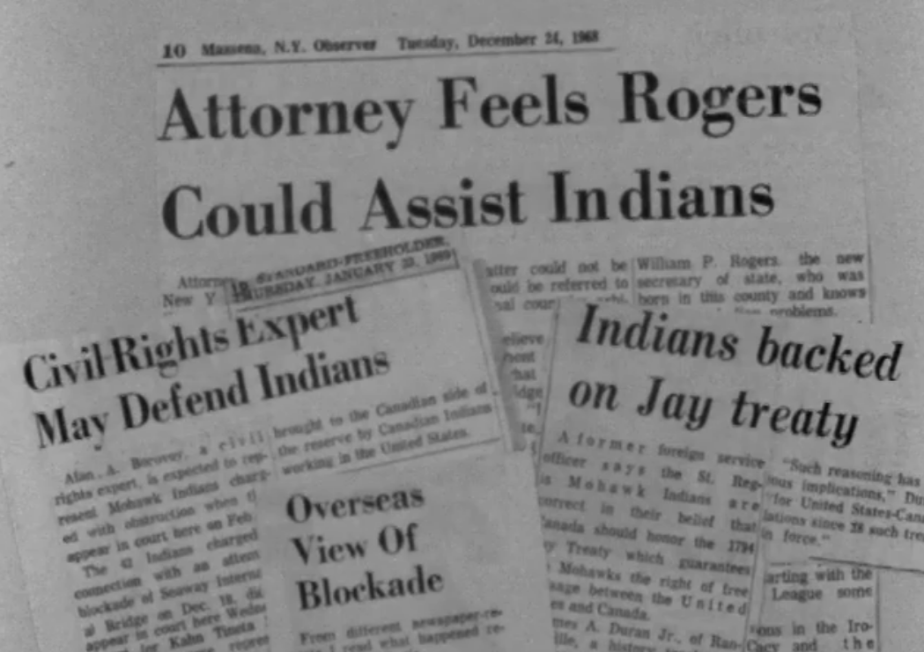
Ironically, this film was created with the community with support and funding from the government. It brings together three spheres of national (government funding), local, (community participation) and public (cinematic mobility and reach). The cinematic becomes a gathering place for renegotiations of authority and agency and transforms into one powerful medium — an impetus for change.
You Are On Indian Land (1969) was filmed in collaboration with a Mohawk activist and filmmaker. This short documentary was part of Challenge For Change, a participatory filmmaking project “braiding” separate threads of power and lack of power into one coherent call to action. The National Film Board project formed The Indian Film Crew in 1968 to encourage, inspire and train First Nations people in filmmaking. Sponsored by private and public stakeholders, participants later went on to work on community development projects.
Affective history has the ability to collapse temporalities. For a film made almost a half-century ago, You Are On Indian Land bears a striking resemblance to present-day politics. The film documents a confrontational “contact zone” where the the Mohawk of the Akwesasene Reserve (then called St. Regis) set up a blockade on a duty road connecting Canada and the United States, where the governments were charging “indians” for crossing on what little was left of their own land. Today, indigenous peoples are part of a new nation, “Blockadia” so termed by journalist Naomi Klein. In places like Standing Rock, Dakota, people are protesting the Dakota Access Pipeline and authorities are using extreme force and incarceration to bully First Nations peoples into submission.
Click on the image to view the film.
 Jenn Leah Ko